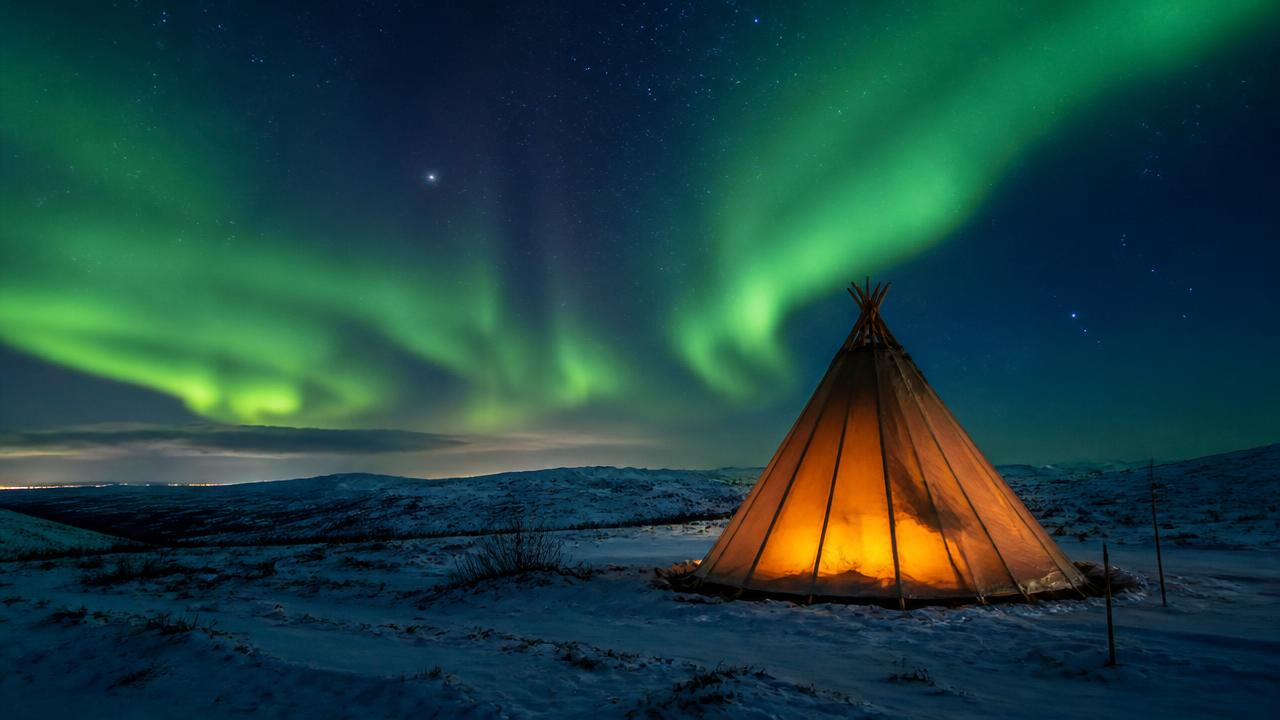
70° north · City of the Northern Lights · Norway
Northern Lights in Alta: The Complete Travel Guide
Alta is one of Northern Norway's most established destinations for seeing the Northern Lights. Located at around 70° north, well above the Arctic Circle and beneath the auroral oval, Alta combines a favourable northern location with dark skies, surrounding wilderness and the ability to search for clearer conditions between the coast and the vast inland areas of Finnmark.
Alta has a long connection with the Northern Lights and is widely known as the City of the Northern Lights.
The main season runs from September until the end of March, although the first aurora can sometimes become visible as early as late August, when sufficiently dark nights return.
But seeing the Northern Lights is never guaranteed. Cloud cover, weather and aurora activity all need to cooperate. The key is not simply being in Alta — it is giving yourself enough opportunities and finding clear, dark sky when the aurora is active.
Below you can compare Northern Lights tour operators in Alta, check the latest aurora forecast and find practical, Alta-specific advice for planning your trip.
Compare experiences
Northern Lights Tour Operators in Alta
Alta has local tour operators offering dedicated Northern Lights chases, small-group experiences, photography-focused tours, private trips and other ways to experience the aurora. Compare the different options below.
No tours in this category right now.
Prices are regular from-prices per person captured at import. Most tours include pickup in Alta — check thermal clothing, meeting point and cancellation terms on the booking page before you pay.
Alta Northern Lights at a Glance
Northern Lights season
September – end of March
First possible displays
Sometimes late August
Location
Around 70°N, above the Arctic Circle
Nickname
City of the Northern Lights
Can you see them from Alta?
Yes
Do you need a tour?
No
Do you need a high KP index?
No
Best strategy
Give yourself several nights
Biggest requirement
Clear, dark sky
Tonight's conditions
Check the live forecast below
Live conditions
Northern Lights Forecast for Alta
A useful forecast is about more than aurora activity alone. To actually see the aurora from Alta you need sufficiently dark skies and — most importantly — breaks in the cloud cover.
View detailed Alta aurora forecastDon't Focus Only on the KP Index
The KP index is useful, but frequently misunderstood. Alta lies beneath the auroral oval, which means you do not necessarily need a major geomagnetic storm to see the Northern Lights.
For someone already in Alta, cloud cover can often be more important than chasing a high KP number. Strong aurora above thick cloud is still invisible.
What if Alta is cloudy?
This is where Alta becomes particularly interesting. Local guides don't necessarily stay around town when conditions are poor. Depending on the weather, they may search for clearer skies towards the coast or inland towards the Finnmark plateau — two very different weather directions to work with.
No forecast can guarantee a display. Use forecasts to identify opportunities — not promises.
Why Is Alta Good for the Northern Lights?
Alta lies at around 70° north, beneath the auroral oval, which gives the region frequent opportunities for aurora activity during the dark season. But latitude is only part of Alta's advantage.
Alta sits between coast and inland Finnmark
Alta is close to Altafjord while also providing access towards the enormous inland landscape of Finnmark. Its climate is therefore neither purely coastal nor purely inland, but a mixture of the two. For Northern Lights hunting, that geography creates something particularly useful: options. When conditions around town are not ideal, guides may search towards the coastline or travel inland towards the plateau.
Relatively stable Arctic conditions
Alta is known locally for its relatively stable climate. That doesn't mean clear skies are guaranteed — they aren't. But Alta's geographical setting is one reason the destination has developed such a long association with Northern Lights observation.
Dark surroundings close to town
You don't need to travel enormous distances to find significantly darker surroundings. Outside the brighter parts of town, artificial light decreases quickly and the landscape opens towards forests, valleys, fjord areas and inland terrain.
Alta: The City of the Northern Lights
Alta's connection with the aurora goes deeper than modern Northern Lights tourism. The destination has long been associated with aurora observation and research.
The world's first permanent Northern Lights observatory was built on Mount Haldde near Alta at the end of the 19th century. Scientists used the remote mountain observatory to study the aurora and its relationship with weather and Earth's magnetic field.
That history is one reason Alta became known as the City of the Northern Lights.
When Can You See the Northern Lights in Alta?
The main season in Alta runs from September until the end of March. In some years, sufficiently dark conditions allow the first Northern Lights towards the end of August. Aurora activity occurs throughout the year — the limitation outside the season is darkness. During summer the sky simply doesn't get dark enough.
September & October
The main season begins. Dark evenings have returned while the landscape can still hold its autumn colours — a very different environment from midwinter.
November & December
Nights become extremely long as Alta moves towards Polar Night. Many hours of darkness are available, but darkness alone does not guarantee aurora: clear sky and activity are still required.
January & February
The classic deep-winter Alta experience. Snow-covered landscapes, long nights and very cold temperatures, with daylight gradually returning after Polar Night.
March
An attractive combination of winter conditions, much more daylight during the day and nights that remain dark enough for Northern Lights watching.
What Is the Best Month to See the Northern Lights in Alta?
There is no single month when the Northern Lights are guaranteed to be stronger. The most important ingredients are darkness, clear skies, aurora activity, patience and enough nights in Alta.
Instead of searching for one “perfect” month, choose according to the conditions you want around your experience. September and October can provide autumn landscapes and milder conditions. December through February bring long nights and deep winter. March combines winter scenery with increasing daylight.
Whatever month you choose, several nights give you more opportunities for clear sky and aurora activity to coincide.
What Time Do the Northern Lights Appear in Alta?
There is no fixed schedule. Northern Lights can appear whenever the sky is sufficiently dark and conditions are right. Evening through the hours around midnight is often a useful period, but displays can occur earlier or later.
Some nights the aurora appears quickly. Other nights require several hours of waiting. Local tours reflect this unpredictability: some last only a few hours, others remain out considerably longer depending on conditions.
Can You See the Northern Lights From Alta?
Yes. Northern Lights can be visible directly from Alta when skies are clear and activity is sufficient. You do not necessarily need to travel deep into the wilderness.
Artificial lighting does, however, reduce contrast. Moving away from bright streetlights makes weaker aurora easier to see and provides a darker overall viewing environment.
Best Places Around Alta to See the Northern Lights
There is no single “best Northern Lights spot” around Alta. Tonight's best location depends on cloud cover, aurora activity, viewing direction, weather, road conditions and safe access. Rather than exact roadside pins, think in directions and areas.
Alta / Edge of Town
You don't need to travel far. Moving away from the brightest commercial and residential areas improves darkness noticeably while keeping you close to town.
Easy accessAltafjord / Coastal Direction
When inland conditions are less favourable, the coast can offer a different weather situation and broader horizons over open water.
FjordKåfjord Direction
A coastal direction with dark surroundings — historically tied to Alta's aurora research at Haldde.
Dark skyRafsbotn Direction
At the inner end of the fjord, a useful direction when you want to move away from town lights without going far.
Easy accessEiby / Inland Direction
Inland valleys where the weather often differs from the fjord — a common first move when the coast is clouded over.
InlandGargia / Finnmark Plateau Direction
Towards the vast inland plateau: very dark, very open and often clearer than the coast. Also the coldest option.
Open horizonCoast or inland — Alta's two weather directions
When inland conditions are less favourable, the coastal direction can provide a different weather situation and broader horizons around the fjord. The opposite strategy is to move inland: local guides regularly travel towards the Finnmark plateau when forecasts suggest clearer skies there. This is one of Alta's most useful geographical advantages.
Northern Lights Tour or See Them on Your Own?
Both approaches can work well in Alta. The right choice depends on your transportation, winter-driving experience and ability to interpret weather conditions.
Joining a Northern Lights chase
A chase adds local weather knowledge and mobility. Guides review cloud cover and aurora conditions before choosing whether to stay near Alta, head towards the coast or travel inland.
Fixed Northern Lights experiences
Some experiences stay primarily at one location, often with a fire, food or another activity. Comfortable — but if clouds move in, the experience generally cannot chase clear sky elsewhere.
Seeing them independently
A car gives real flexibility around Alta. But Arctic winter driving — snow, ice, darkness and fast-changing conditions — should not be underestimated.
How to Choose a Northern Lights Tour in Alta
Not all Northern Lights tours offer the same experience. Compare more than price.
Chase or fixed location?
Check this first. Does the operator actively change route with the weather, or does the evening mainly happen in one place? Neither is better — they are different products.
Group size
Alta has everything from very small vehicle-based tours to much larger groups.
Duration
Some Alta tours last a few hours, others continue for five or six depending on the concept and conditions.
How far will they chase?
If Alta is clouded over, does the operator travel towards the coast or inland? That can be the most meaningful difference between two tours.
Photography
Check whether camera assistance and tripods are provided, whether the guide photographs and whether guest photos are included afterwards.
Warm clothing
Check whether thermal suits, winter boots, hats and mittens are included — do not assume every tour provides the same.
Food and drinks
Hot chocolate, coffee, snacks, soup or campfire food vary between operators. Check inclusions before comparing prices.
Pickup, drop-off & cancellation
Some tours include hotel pickup and drop-off, others depart from a fixed meeting point or charge separately. Compare cancellation terms, not just ticket price.
What to Wear for the Northern Lights in Alta
Northern Lights hunting often means standing outside for long periods at night, and Alta can become very cold during winter. Dress in layers: wool or thermal base layers, an insulating mid-layer and proper winter outerwear.
- Wool or thermal base layers
- Insulating mid-layers
- Warm winter jacket
- Insulated trousers
- Warm winter boots
- Wool socks
- Hat
- Gloves or mittens
- Neck warmer
- Hand and foot warmers
How Many Nights Do You Need in Alta?
If seeing the Northern Lights is an important reason for visiting Alta, avoid relying on a single night. Even in a destination known for relatively stable weather, clouds can interfere. For many visitors, four to five nights provides useful flexibility — longer stays naturally provide even more opportunities.
Do You Need a Car to See the Northern Lights in Alta?
No. Northern Lights can sometimes be visible directly from Alta, and organised tours provide transportation. However, a car gives independent travellers significantly more flexibility to reach darker surroundings and respond to changing cloud conditions.
Winter driving around Alta can involve:
- Snow
- Ice
- Very low temperatures
- Darkness
- Blowing snow
- Reduced visibility
- Rapidly changing road conditions
If you are not comfortable driving in Arctic winter conditions, joining a guided tour removes much of that responsibility.
Northern Lights Safety Around Alta
Northern Lights hunting takes place in darkness and often during Arctic winter conditions.
- Never stop your vehicle in the road when the aurora appears.
- Find a legal, safe place to pull completely away from traffic.
- Use reflective clothing or a light if walking near roads after dark.
- Check weather and road conditions before travelling away from Alta.
- Take extra care on snow-covered roads, icy surfaces and unfamiliar terrain.
- Be careful around frozen lakes and rivers, remote areas and extreme cold.
Insider tip: don't trust ice because it looks solid
Frozen water can look like the perfect Northern Lights foreground. That does not mean the ice is safe. Unless current local information confirms a frozen surface is safe to use, stay on known safe ground.
Insider tip: cold is part of the safety plan
Don't underestimate how quickly standing still outside becomes uncomfortable in very low temperatures. Keep extra warm clothing available and know when it's time to return to the vehicle or shelter.
Can the Northern Lights Be Guaranteed in Alta?
No. No destination, tour operator or forecast can guarantee that you will see the Northern Lights. Local operators may have extensive experience finding clear skies, but the aurora remains a natural phenomenon. Treat any historical sighting rate as information about that operator's past tours — not a guarantee for yours.
Stay several nights. Check the forecast. Find clear sky. Stay flexible.
Practical answers
Alta Northern Lights FAQ
Plan Your Northern Lights Experience in Alta
Alta combines a location beneath the auroral oval with dark Arctic surroundings and something particularly useful for aurora hunting: options. Coast or inland. Close to town or farther away. A guided chase or an independent evening under clear skies. Give yourself several nights, check the forecast, find clear sky, stay flexible — and whenever darkness falls over Alta: look up.