Vík and the village edge
Begin around Vík itself. Move away from direct street lighting while keeping established access and an open view.
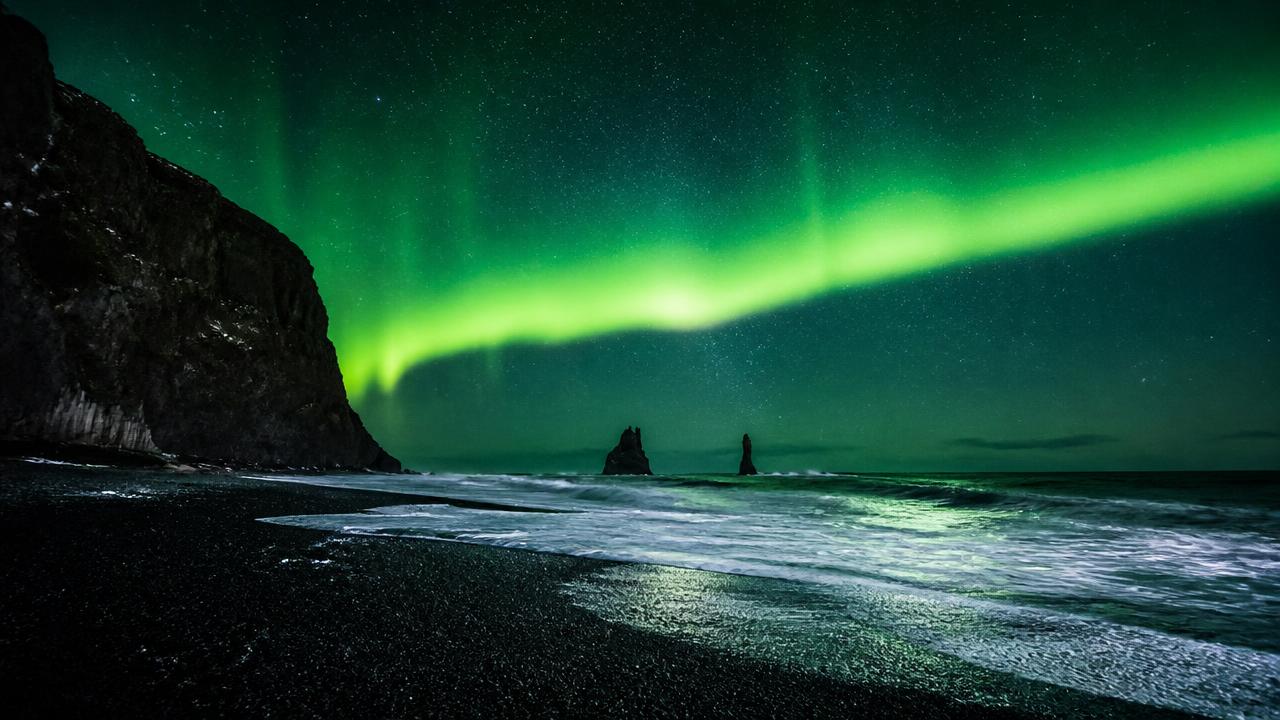
63° north · South Coast · Iceland
Vík is a small village on Iceland's South Coast and a convenient base for seeing the Northern Lights away from Reykjavík's bright lights.
Dark coastal landscapes, mountains and open countryside make it easy to find darker skies without travelling far. Displays are generally visible from September through April, and sometimes from late August.
Cloud cover and rapidly changing weather determine whether you see anything. The key is not one famous spot—it is finding dark, clear sky.
Below you can compare local options, check tonight's forecast and find practical advice on when and where to look.
Local departures first
Vík has a smaller market than Reykjavík. These are the northern lights tours that visit Vík and the South Coast. Most start in Reykjavík, so each card shows where it begins.
Most northern lights tours that pass Vík start in Reykjavík and visit the South Coast as a day trip or multi-day tour. Check the starting location before booking.
Northern Lights season
September – April
Possible first displays
Late August
Can you see them from Vík?
Yes
Do you need a tour?
No
Main advantage
Dark surroundings close to the village
Main challenge
Cloud cover and South Coast weather
Best strategy
Check cloud cover and stay flexible
Tonight's conditions
Check the live forecast below
Live conditions
For Vík, cloud cover deserves as much attention as aurora activity. You need darkness, clear enough sky and aurora activity. Thick cloud hides even a strong display.
View detailed Vík aurora forecastThe KP index describes broad geomagnetic activity, but it cannot tell you whether the sky above Vík is clear. A modest forecast beneath clear sky can be more useful than stronger activity hidden behind cloud.
Cloud can vary along the South Coast. Check where clearer conditions are actually forecast before changing location, then confirm current road and weather conditions.
Vík's main advantage is simple: dark surroundings are close. You do not need a long drive merely to escape major urban light pollution.
The village sits between the Atlantic coast and South Iceland's mountains, with darker countryside nearby. Its Ring Road position can also support a safe change of location when cloud differs along the coast.
Viewing is generally possible from September through April, with occasional late-August displays once sufficiently dark nights return.
September & October
Dark nights return while conditions are still autumnal rather than deep winter. Northern Lights are possible, but snow is not guaranteed.
November – February
These months provide long periods of darkness. Weather remains the major variable, particularly along Iceland's South Coast.
March
Nights remain dark enough for Northern Lights while daylight hours increase considerably.
April
Aurora can still be visible during sufficiently dark hours, but the viewing window becomes shorter as summer approaches.
No single month guarantees a display. Darkness, clear sky, aurora activity and enough opportunities matter more than one perfect calendar date.
There is no fixed time. Late evening and the hours around midnight are commonly useful, but displays can occur earlier or later whenever the sky is dark enough.
Yes. Because Vík is small, artificial light is less of an obstacle than in a large city. Moving away from the brightest streetlights can improve weak displays.
Tonight's choice depends on cloud, light, viewing direction, wind, roads and safe access. We keep this deliberately small instead of publishing unverified roadside pins.
Begin around Vík itself. Move away from direct street lighting while keeping established access and an open view.
When Vík is cloudy, compare safer established areas in other directions. Do not improvise roadside stops.
Map access is being verified
Reynisfjara, Dyrhólaey and other nature sites will not receive exact nighttime pins until access, parking, restrictions, winter conditions and visitor safety are verified.
Reynisfjara is famous—and dangerous. Large, unpredictable waves can reach much farther up the beach than visitors expect. Darkness makes judging the ocean, distance and terrain even harder.
Never approach the shoreline for an aurora photo. Stay well away from the water and follow every current warning, closure and safety instruction.
Start by checking the sky around the village. A car adds flexibility when cloud differs elsewhere, but also adds winter-driving responsibility.
A guide can provide transport, local weather knowledge and photography help. Confirm that the experience genuinely starts in or picks up from Vík.
Starting location
Confirm that the tour actually departs from Vík or includes pickup here. A South Coast label does not necessarily mean a local departure.
Mobility
Ask whether the guide can change location according to cloud cover or remains primarily at one site.
Group size
Check the actual maximum number of guests rather than relying on a broad small-group label.
Duration
Aurora does not follow a schedule. Check the usual duration and whether the return time is fixed.
Photography
Confirm whether camera help or photographs of guests are included.
Clothing
Check whether thermal clothing is provided.
Pickup and drop-off
Confirm the exact pickup point and whether return transportation to Vík is included.
Expect cold, wind and moisture while standing outside.
There is no guaranteed number. Several nights create more chances for clear sky and activity to coincide, but many visitors pass through Vík on a wider South Coast or Ring Road journey.
Not necessarily. When the sky above Vík is clear, aurora can be visible close to the village. A car adds flexibility but South Iceland driving can involve:
Check current weather and road conditions before travelling specifically to search for clearer sky.
Safety deserves special attention where famous landscapes meet exposed coastline and rapidly changing weather.
Some South Coast locations have restrictions, seasonal closures or hazards that become harder to recognise after dark. Use established, safe locations.
No. Vík provides dark surroundings and a useful South Coast base, but every sighting still depends on darkness, clear sky and aurora activity.
Check conditions each evening and remain flexible about where you watch from.
Practical answers
Check the forecast. Look for clear sky. Move away from direct light. Change location when cloud requires it—and always put safe access before the perfect photograph.