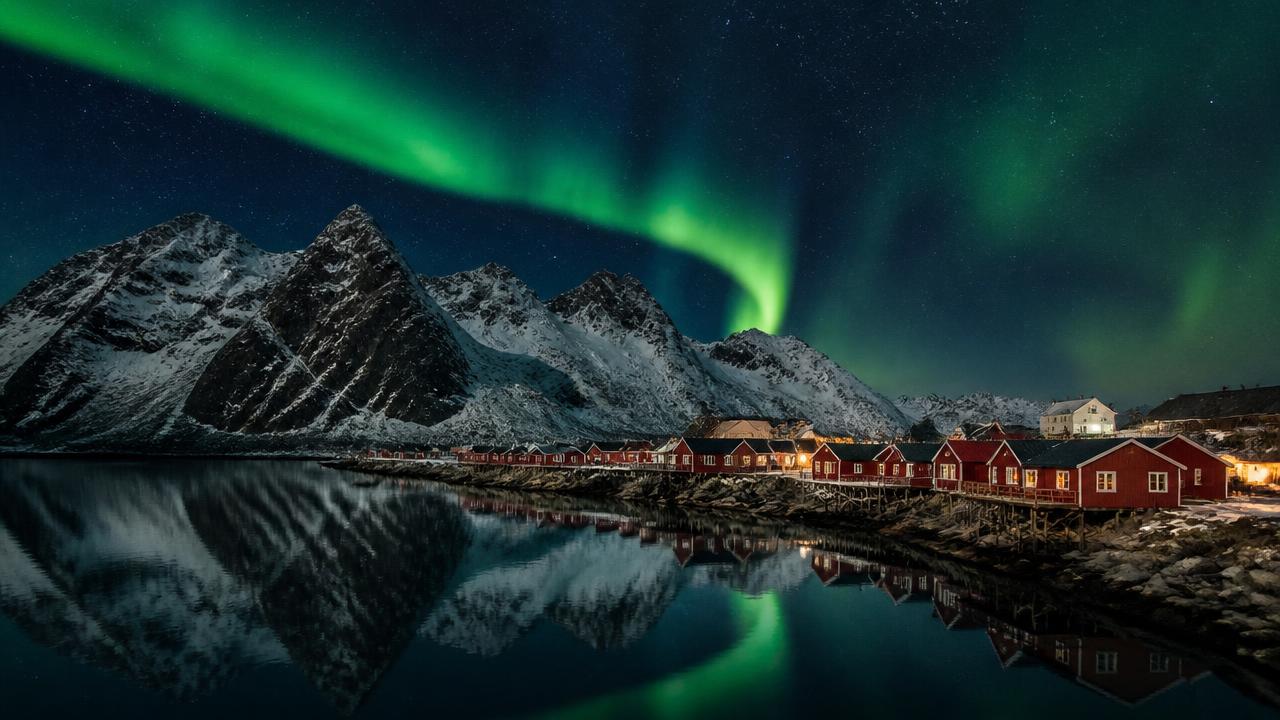
68° north · Arctic Circle · Norway
Northern Lights in Lofoten: The Complete Travel Guide
Lofoten is one of Norway's most spectacular destinations for seeing the Northern Lights. Located above the Arctic Circle at around 68° north, the islands sit beneath the auroral oval and combine dark Arctic skies with dramatic mountains, fjords, fishing villages and beaches.
From late August until around mid-April, the nights in Lofoten become dark enough for the Northern Lights to appear.
But seeing the aurora is never guaranteed. Cloud cover, weather conditions and solar activity all play a role. A successful Northern Lights trip is therefore not simply about choosing Lofoten — it is about knowing when to visit, where to look and how to make the most of each night.
Below you can compare Northern Lights tour operators in Lofoten, check the latest aurora forecast and find practical, Lofoten-specific advice for planning your Northern Lights experience.
Compare experiences
Northern Lights Tour Operators in Lofoten
Lofoten has a selection of local Northern Lights tour operators offering everything from dedicated aurora chases and small-group tours to photography-focused trips, private tours and other Northern Lights experiences. Compare all 0 bookable experiences by operator, verified reviews, duration and regular price.
No tours in this category right now.
Departure points matter in Lofoten because the islands cover a large area — Svolvær, Kabelvåg, Leknes and Reine can be far apart. Most tours start in Svolvær — check the meeting point on the booking page against where you are staying.
Lofoten Northern Lights at a Glance
Northern Lights season
Late August – mid-April
Location
Around 68°N, above the Arctic Circle
Can you see them without a tour?
Yes
Do you need a high KP index?
No
Best strategy
Give yourself several nights
Best viewing condition
Clear, dark sky
Biggest challenge
Cloud cover and changing coastal weather
Tonight's conditions
Check the live forecast below
Live conditions
Northern Lights Forecast for Lofoten
A useful forecast for Lofoten is about more than aurora activity. To actually see the aurora you need sufficiently dark skies and — most importantly — breaks in the cloud cover.
View detailed Lofoten aurora forecastDon't Focus Only on the KP Index
One of the most common mistakes visitors make is treating the KP index as a Northern Lights score. Lofoten lies within the auroral oval, which means you do not necessarily need a high KP index to see the Northern Lights here. Even relatively low geomagnetic activity can produce visible aurora.
For someone already standing in Lofoten, cloud cover often matters more than whether the KP index is 2, 3 or 4. A spectacular aurora above thick clouds is still invisible.
What if Lofoten is cloudy?
Don't give up too early. Lofoten has steep mountains, open sea and rapidly changing coastal weather, so conditions can vary across relatively short distances. The mountains themselves can sometimes contribute to breaking up cloud cover, creating gaps even when much of the sky appears cloudy.
If the forecast shows aurora activity but significant cloud cover, look at conditions across different parts of Lofoten rather than relying on a forecast for only one village.
No forecast can guarantee a Northern Lights display. Use forecasts as planning tools, not promises.
Why Is Lofoten Good for the Northern Lights?
Lofoten lies within the auroral oval, the region around Earth's geomagnetic poles where auroral activity occurs most frequently. You do not necessarily need an extreme geomagnetic storm: when the sky is sufficiently dark and clear, aurora can appear even during relatively modest activity.
But Lofoten's biggest advantage is not simply its latitude. It is the landscape and access to open skies — north-facing beaches, open ocean horizons, fjords and dramatic mountains with relatively little artificial light outside the main settlements. Many viewing areas can also be reached from the E10 and surrounding roads, making it possible to change location when conditions require it.
When Can You See the Northern Lights in Lofoten?
The Northern Lights can normally be seen in Lofoten from late August until around mid-April, when the sky becomes sufficiently dark. The main travel season is generally September to early April. Aurora activity occurs throughout the year, but Lofoten's summer sky is too bright to see it.
September & October
Dark nights have returned while temperatures are generally milder than midwinter. Good for visitors who want aurora without a full winter experience — but snow is not guaranteed at lower elevations.
November & December
The nights become very long, giving many hours of darkness for aurora hunting. Longer nights do not automatically mean more Northern Lights: cloud cover and activity still need to cooperate.
January & February
Classic Lofoten winter. Snow-covered mountains and beaches create the Arctic landscape many travellers associate with Northern Lights photography.
March
An attractive combination of winter landscapes, increasing daylight for exploring, and nights that remain dark enough for aurora hunting.
Early to mid-April
Aurora can still be visible, but the nights brighten rapidly. By around mid-April the sky is generally too bright for reliable viewing.
What Is the Best Month to See the Northern Lights in Lofoten?
There is no single month when the Northern Lights are guaranteed to be stronger or more visible. The most important ingredients are darkness, clear skies, aurora activity, patience and enough nights in Lofoten.
Instead of searching for one “perfect” month, think about the conditions you want around your Northern Lights experience. If you prefer milder conditions and autumn landscapes, September and October can be attractive. If snowy mountains and beaches are important to you, January through March is generally more suitable. March can be particularly interesting if you want more daylight while still having dark enough nights.
Whatever month you choose, several nights give you more room to work around the weather.
What Time Do the Northern Lights Appear in Lofoten?
There is no fixed schedule. Aurora can appear whenever the sky is sufficiently dark and conditions are right. Under typical conditions, the Northern Lights in Lofoten are often seen during the evening and around midnight — but they can appear earlier or later.
Some nights begin with a faint arc over the northern horizon. Other nights develop into activity stretching across much of the sky. Patience matters.
Can You See the Northern Lights From Villages in Lofoten?
Yes. Strong Northern Lights can be visible directly from villages throughout Lofoten. Because much of Lofoten has relatively low levels of artificial light, you often do not need to travel as far from populated areas as you might expect.
However, artificial light still reduces contrast. For better viewing conditions, move away from bright streetlights and find somewhere with an open view of the sky.
Best Places in Lofoten to See the Northern Lights
There is no single “best Northern Lights spot” in Lofoten. The best location on a particular night depends on cloud cover, aurora activity, viewing direction, wind, road conditions and safe access. These areas are particularly well suited to aurora watching.
Svolvær
The main town in eastern Lofoten and a common departure point for tours. Move away from street lighting for better contrast.
Easy accessGimsøy / Hov
Open landscapes and a north-facing coastline with little artificial light. Broad views towards the sea.
North-facingUttakleiv
Lofoten's best-known aurora beach, facing the northern sky — ideal when activity is low or moderate. Mountains close in from west to east.
North-facingHaukland
Minutes from Uttakleiv but with a different viewing direction — useful when the display moves west or overhead.
BeachVik
Neighbouring Haukland, with an open view towards the west and southwest on active nights.
BeachUnstad
Surrounded by mountains but open towards the sea, and far from larger settlements.
Low artificial lightEggum
On the northern side of Vestvågøy with an open sea horizon — good for lower activity towards the north.
Open horizonFlakstad & Ramberg
Beaches and coastal areas that combine dark surroundings with dramatic mountain scenery.
PhotographyReine & western Lofoten
Some of Lofoten's most recognisable landscapes. Steep mountains can restrict parts of the horizon depending on exactly where you stand.
PhotographyUttakleiv, Haukland and Vik work best as one system
Uttakleiv faces the northern sky, which makes it particularly useful when aurora activity is low or moderate. But it is surrounded by mountains from west to east. When activity increases and moves higher across the sky, parts of the display can move behind those mountains — and nearby Haukland or Vik can provide a more useful view towards the west and southwest.
Northern Lights Tour or See Them on Your Own?
Both approaches work particularly well in Lofoten. The right choice depends on your transportation, winter-driving experience and how comfortable you are interpreting changing weather.
Joining a Northern Lights chase
Guides monitor cloud cover, weather and aurora forecasts before choosing where to go — valuable in Lofoten, where conditions vary between islands and the best spot can change during the evening.
Northern Lights photography tours
Lofoten's landscape makes photo-focused tours especially relevant: local knowledge of beaches, mountains and compositions, combined with help on camera settings.
Seeing them independently
Many dark viewing areas are reachable from the E10 and surrounding roads. Winter driving should not be underestimated — snow, ice, wind and fast-changing conditions make short distances harder than they look.
How to Choose a Northern Lights Tour in Lofoten
Not all Northern Lights tours are the same. Before booking, compare more than the price.
Starting location
This matters most in Lofoten. Check whether the tour departs from Svolvær, Kabelvåg, Leknes, Reine or elsewhere, and compare with where you're staying.
Group size
Check the maximum group size rather than assuming all tours are similar.
Mobility
Is it a genuine chase where the route changes with conditions, or an experience at a fixed location?
Duration
Check how long the tour normally lasts and whether the return time is fixed.
Photography
Check whether the guide provides camera assistance and whether photos of guests are included.
Warm clothing
Check whether thermal clothing is provided.
Pickup & drop-off
Lofoten is geographically spread out — confirm the exact meeting point before booking.
What to Wear for the Northern Lights in Lofoten
Northern Lights hunting often means standing outside for long periods at night. Lofoten's coastal climate means wind and moisture can make conditions feel considerably colder than the temperature suggests. Dress in warm layers: wool or thermal base layers, an insulating mid-layer, and warm outerwear that protects against wind and moisture.
- Wool or thermal base layers
- Insulating mid-layers
- Wind-resistant outerwear
- Warm waterproof boots
- Wool socks
- Hat
- Gloves or mittens
- Neck warmer
How Many Nights Do You Need in Lofoten?
If the Northern Lights are an important reason for visiting Lofoten, avoid planning around a single night. Coastal weather can be unpredictable, and a stay of several nights gives you more opportunities for clear skies and aurora activity to coincide. For many visitors, four to five nights provides useful flexibility.
Do You Need a Car to See the Northern Lights in Lofoten?
No — but having transportation provides significantly more flexibility. If you are staying somewhere with dark surroundings, Northern Lights can sometimes be visible directly outside, and guided tours provide transportation. Independent hunting becomes considerably easier with a car, because Lofoten covers a large area and cloud conditions vary between locations.
But that flexibility comes with responsibility. Winter conditions can include:
- Snow-covered roads
- Black ice
- Slush
- Strong winds
- Blowing snow
- Limited visibility
- Narrow roads
- Rapidly changing weather
The E10 can experience very different conditions during the same day, and exposed sections and bridges can be affected by strong winds. If you are not comfortable driving in Arctic winter conditions, a guided tour may be a better option.
Northern Lights Safety in Lofoten
Lofoten's landscapes are spectacular, but Northern Lights hunting happens in darkness and often during winter conditions.
- Never stop your vehicle in the road when the aurora appears.
- Use designated parking areas or marked lay-bys, fully away from traffic.
- Don't block roads, driveways, farm access or snow-clearing access.
- Never block private property.
- Take extra care around beaches and rocks after dark — waves are unpredictable.
- Check weather and road conditions before moving between locations.
Insider tip: a parking area is part of the aurora plan
Don't choose only where you want to photograph. Also ask: where can I safely park? If there is nowhere legal and safe to stop, choose another viewing location. Lofoten has plenty of alternatives.
Insider tip: Uttakleiv is a community, not just a photo location
Uttakleiv is a small community and the visitor area is privately managed by local residents. Use the designated parking facilities, follow signs and respect local rules — throughout Lofoten, enjoy the aurora without making life harder for the people who live underneath it.
Can the Northern Lights Be Guaranteed in Lofoten?
No. No tour operator, destination or forecast can guarantee that you will see the Northern Lights. Aurora is a natural phenomenon, and visibility depends on several factors occurring at the same time.
Stay several nights. Check the forecast. Find clear sky. Stay flexible.
Practical answers
Lofoten Northern Lights FAQ
Plan Your Northern Lights Experience in Lofoten
Lofoten combines a location beneath the auroral oval with some of Norway's most dramatic Northern Lights landscapes. Give yourself several nights, check the forecast, find clear sky, watch the horizon — and be willing to change location. Whenever darkness falls over Lofoten: look up.