Four countries, four different trips
The aurora does not become fundamentally different when you cross a national border. All four countries have destinations within or close to the auroral zone, and all can offer spectacular displays when the conditions are right.
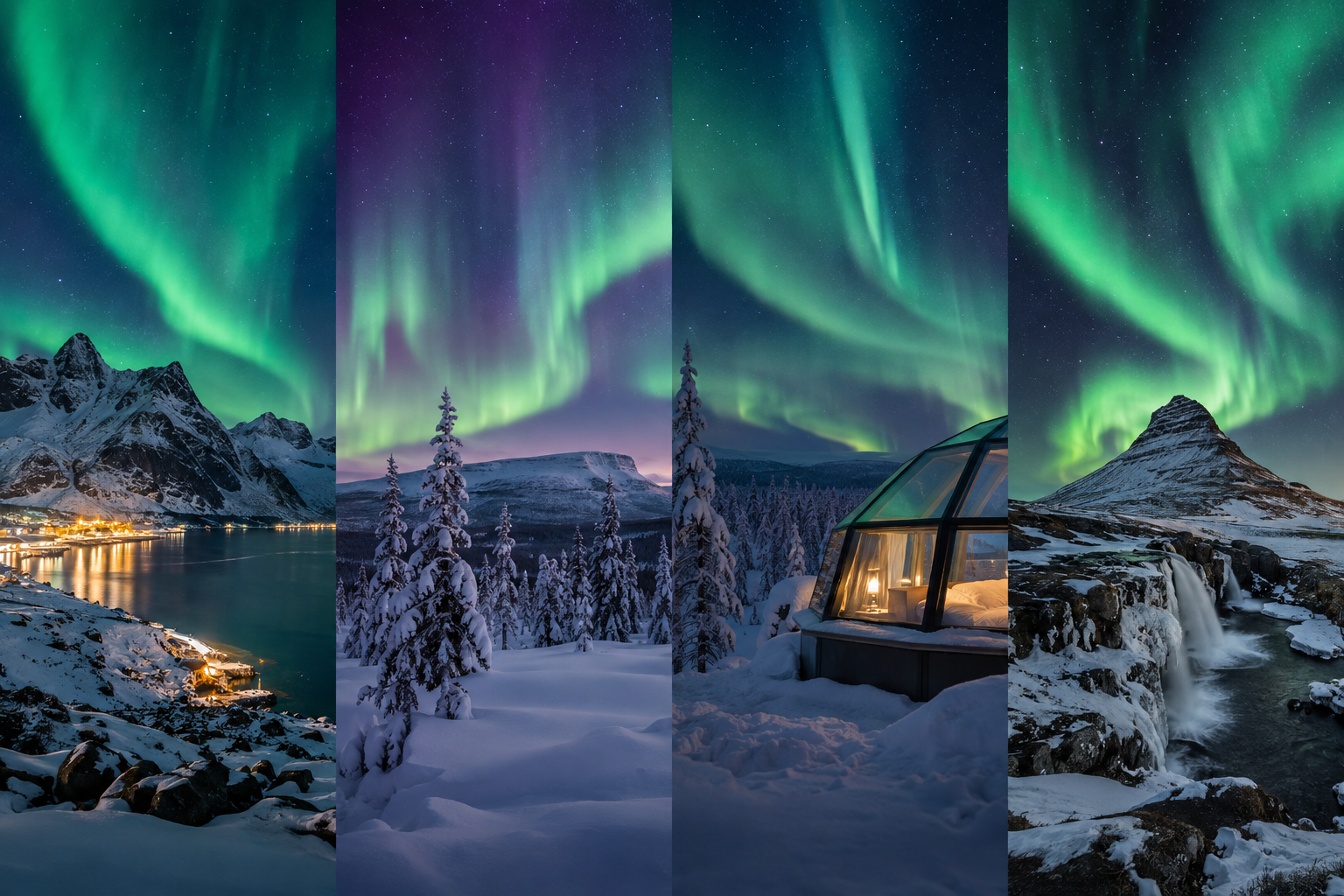
What changes is everything around the aurora. Norway brings fjords and mountains; Sweden offers the Arctic landscapes around Kiruna and Abisko; Finland combines forests, frozen lakes and glass-roofed accommodation; Iceland pairs aurora hunting with volcanoes, waterfalls, glaciers, hot springs and road trips.
This guide compares the four countries to help you choose the northern lights destination that suits your trip.
Destination map
Aurora bases across the Nordic region
Norway, Sweden, Finland or Iceland: The quick comparison
The seasons below are approximate. Darkness, cloud cover and auroral activity determine what you can see on any particular night.
Norway
Late August or September to March or April · Fjords, mountains, islands and coast · Established aurora bases and mobile tours.
Explore NorwaySweden
September to March · Mountains, forests and frozen landscapes · Arctic wilderness around Abisko and Kiruna.
Explore SwedenFinland
Late August to early April · Forests, frozen lakes and fells · Lapland activities and aurora-focused accommodation.
Explore FinlandIceland
Late August to April · Volcanoes, waterfalls, glaciers and coast · Aurora combined with a classic Iceland road trip.
Explore IcelandNorthern Lights in Norway
Northern Norway sits underneath the auroral zone and contains some of Europe’s most established northern lights destinations. Tromsø is perhaps the best-known starting point, but travelers also head to Alta, Senja, the Lyngen Alps, Lofoten, Vesterålen and the North Cape region.
Norway gives you the opportunity to see the aurora against mountains, fjords, fishing villages, islands and open sea. For photographers in particular, these can create spectacular foregrounds and a very different experience from the forested landscapes of northern Finland and Sweden.
Northern Norway also has a well-developed winter tourism industry. Tromsø offers a large selection of hotels, restaurants and organized aurora tours, making it easy to use a city as a base while reaching darker skies at night. You can also build a longer journey around several northern destinations.
The coastline creates one of Norway’s greatest attractions — and one of its challenges. Weather can change quickly, with clouds covering one area while another location nearby has clear skies. This is why many tours are mobile and why independent travelers should check the cloud forecast as carefully as the aurora forecast.
Norway may suit you if you want dramatic mountains, fjords and Arctic coastal scenery, or prefer a city such as Tromsø as your base.
Northern Lights in Sweden
Northern Sweden offers a different Arctic experience. Kiruna is one of the main gateways to Swedish Lapland, while Abisko has developed an international reputation as an aurora-viewing destination. The main season generally runs from September through March.
For many travelers, the appeal is the combination of northern lights and Arctic wilderness: mountains, forests, snow and large open landscapes rather than coastal fjords. Abisko National Park creates a setting very different from the Norwegian coast.
You may encounter claims that Abisko is virtually guaranteed clear skies or has a magical weather phenomenon that always removes clouds. Treat those claims with caution. It is known for relatively favorable viewing conditions, but no destination can guarantee clear weather or aurora. You still need darkness, clear sky and auroral activity.
Kiruna can work well as a base for a broader winter trip. The region offers classic Swedish Lapland activities, and the ICEHOTEL is located in nearby Jukkasjärvi.
Sweden may suit you if you are attracted to Arctic wilderness and snowy landscapes, like the idea of combining Kiruna with Abisko, or prefer a smaller Arctic destination to a larger city base.
Northern Lights in Finland
Finland offers perhaps the most recognizable version of the classic Lapland winter holiday: forests, frozen lakes, deep snow, reindeer experiences, saunas and a large Arctic travel industry. The northern lights season in Finnish Lapland generally runs from late August until early April.
Visit Finland notes that auroras appear on roughly every second clear night in Lapland during the season. That does not mean a 50 percent chance on every individual night — weather, location and auroral conditions still matter — but it helps explain why northern Finland is so established.
Accommodation is a major part of the appeal. Finland is particularly known for glass-roofed cabins, aurora cabins, wilderness lodges, igloo-style accommodation and resorts designed around winter experiences. A glass roof does not guarantee aurora; clouds remain clouds regardless of the room.
Instead of fjords or volcanic scenery, Finland is characterized by forests, frozen lakes and fells. Depending on where you stay, you can combine aurora viewing with husky sledding, reindeer experiences, snowmobiling, snowshoeing, cross-country skiing, sauna and ice fishing.
Inland Lapland can be much colder than coastal aurora destinations, with winter temperatures sometimes reaching around −30°C. Finland may suit you if you want a complete Lapland winter experience with snowy forests, glass cabins and winter activities.
Northern Lights in Iceland
Iceland offers perhaps the most different overall travel experience. For many visitors, the northern lights are one part of a larger trip through waterfalls, glaciers, black-sand beaches, geothermal areas and volcanic landscapes. The aurora season runs approximately from late August until late April.
Few destinations let you combine northern lights with such a concentration of waterfalls, glaciers, volcanoes, lava fields, geothermal areas, hot springs and rugged coastlines. Iceland is particularly appealing when aurora matters, but is not the only reason for your trip.
Unlike Norway, Sweden and Finland, where travelers generally head to the far north, Iceland itself sits within the auroral zone. You can use Reykjavík as a base and travel away from city lights, explore the South Coast around Vík, or build aurora hunting into a longer road trip.
Weather can change rapidly, so cloud cover is extremely important. Clear or partly clear, sufficiently dark skies are required. Flexibility helps: clouds in one area do not necessarily mean the entire evening is lost if conditions are better elsewhere and travel is practical and safe.
Iceland may suit you if you want the northern lights to be part of a larger nature and road-trip experience — and would still consider the vacation successful if the aurora did not appear.
Reykjavík
A convenient base for road and boat tours beyond the brightest city lights.
Explore ReykjavíkWhich country has the best chance?
There is no simple country-level answer. Your actual chance depends on where you are, your latitude and position relative to the aurora oval, cloud cover, darkness, geomagnetic activity, light pollution, how many nights you stay and whether you can move when conditions are poor.
A traveler spending five clear nights in northern Finland may have a much better opportunity than someone spending one cloudy night in northern Norway — and the opposite can just as easily happen. The specific destination and conditions matter more than the flag on the map.
Do not choose a country based only on KP
The KP index is useful, but it should not decide which country you visit. Much of northern Scandinavia and Iceland lies within or close to the normal auroral zone, so the northern lights can be visible even at relatively low KP levels.
Clouds are often the more immediate problem. A KP 5 storm above an overcast sky will not help much; a clear, dark night under the auroral oval at KP 1 or KP 2 may be far more rewarding.
Think about weather — but not months ahead
You cannot reliably know the cloud cover for a particular night several months before your trip. Instead of selecting a country from a long-range prediction, build flexibility into your plans.
Spend several nights in the aurora region, check local forecasts when you arrive, and be prepared to move toward clearer areas when practical and safe.
How many nights should you stay?
One of the easiest ways to improve your chances is to give yourself more than one opportunity. Planning an entire trip around a single evening is risky because excellent geomagnetic conditions can still be hidden by clouds.
Several nights give darkness, clear sky and auroral activity more chances to line up. If seeing the northern lights is a main reason for the trip, spend at least a few nights in a good aurora region rather than treating it as a one-night excursion.
Which country is best for a road trip?
Norway and Iceland both suit trips where the landscape is a major part of the journey, but they are very different. Norway offers fjords, mountains, islands and fishing villages; Iceland offers volcanoes, waterfalls, glaciers, lava fields and geothermal landscapes.
Winter driving in either country can be challenging. Snow, ice, wind, darkness and rapidly changing conditions should be taken seriously. If you are not comfortable driving in winter, organized tours can be much easier.
Finland and Sweden can also be explored by car, although many travelers choose a fixed base and combine local activities with organized aurora excursions.
Which country is best without a car?
You do not need to rent a car. Established destinations in all four countries offer guided tours, and Tromsø, Kiruna, Rovaniemi and Reykjavík can all function as bases for organized excursions.
A local guide may understand weather patterns, road conditions and viewing locations better than a first-time visitor. Avoiding unfamiliar snowy or icy roads can also make the trip considerably more relaxing.
What else do you want from the trip?
The northern lights are unpredictable, so ask what you would enjoy even if they did not appear. Choose Norway for fjords and coastal mountains; Sweden for Arctic wilderness around Abisko and Kiruna; Finland for glass cabins, forests, saunas, huskies and a classic Lapland winter; or Iceland for waterfalls, glaciers, volcanoes, geothermal landscapes and a road trip.
The aurora can be the reason you travel north. It does not have to be the only reason you enjoy the trip.
Frequently asked questions
Is Norway, Sweden, Finland or Iceland better for northern lights?
All four have excellent destinations. Compare specific places, scenery, access, activities and the kind of vacation you want.
Which country has the longest northern lights season?
All four have long seasons covering much of autumn, winter and early spring. Practical dates vary by latitude, destination and available darkness.
Is Iceland or Scandinavia better?
Northern Scandinavia offers many deep-Arctic bases; Iceland combines aurora with compact volcanic, glacial and geothermal journeys. Clouds and activity matter more on an individual trip.
Is Finland or Norway better?
Finland is known for forests, frozen lakes and Lapland resorts. Northern Norway offers mountains, fjords, islands and coastal scenery.
Is Abisko good for northern lights?
Yes. It is an established destination near the auroral zone, but it cannot guarantee aurora or clear skies.
Can you see the northern lights from Reykjavík?
Yes, when conditions are favorable. Leaving the brightest city lights gives a darker viewing environment.
Can you see the northern lights from Tromsø?
Yes. Tromsø is in a favorable aurora region, and many visitors travel outside the city for darker skies and clearer weather.
How many days should I plan?
No number guarantees a sighting, but several nights are much better than relying on one evening.
The bottom line
Norway, Sweden, Finland and Iceland can all deliver extraordinary northern lights experiences. The useful question is not ‘Which country has the best northern lights?’ but ‘What kind of trip do I want around the northern lights?’
Choose Norway for Arctic coastal landscapes, Sweden for Abisko, Kiruna and wilderness, Finland for a classic Lapland winter, or Iceland for waterfalls, glaciers, volcanoes and a road trip.
Then give yourself several nights, stay flexible and keep an eye on the clouds. Whichever country you choose, the same rule applies: the best northern lights destination is only as good as the sky above you that night.
Ready to pick a place?
Every destination page shows tonight's aurora outlook calculated from its own coordinates.
Explore destinations