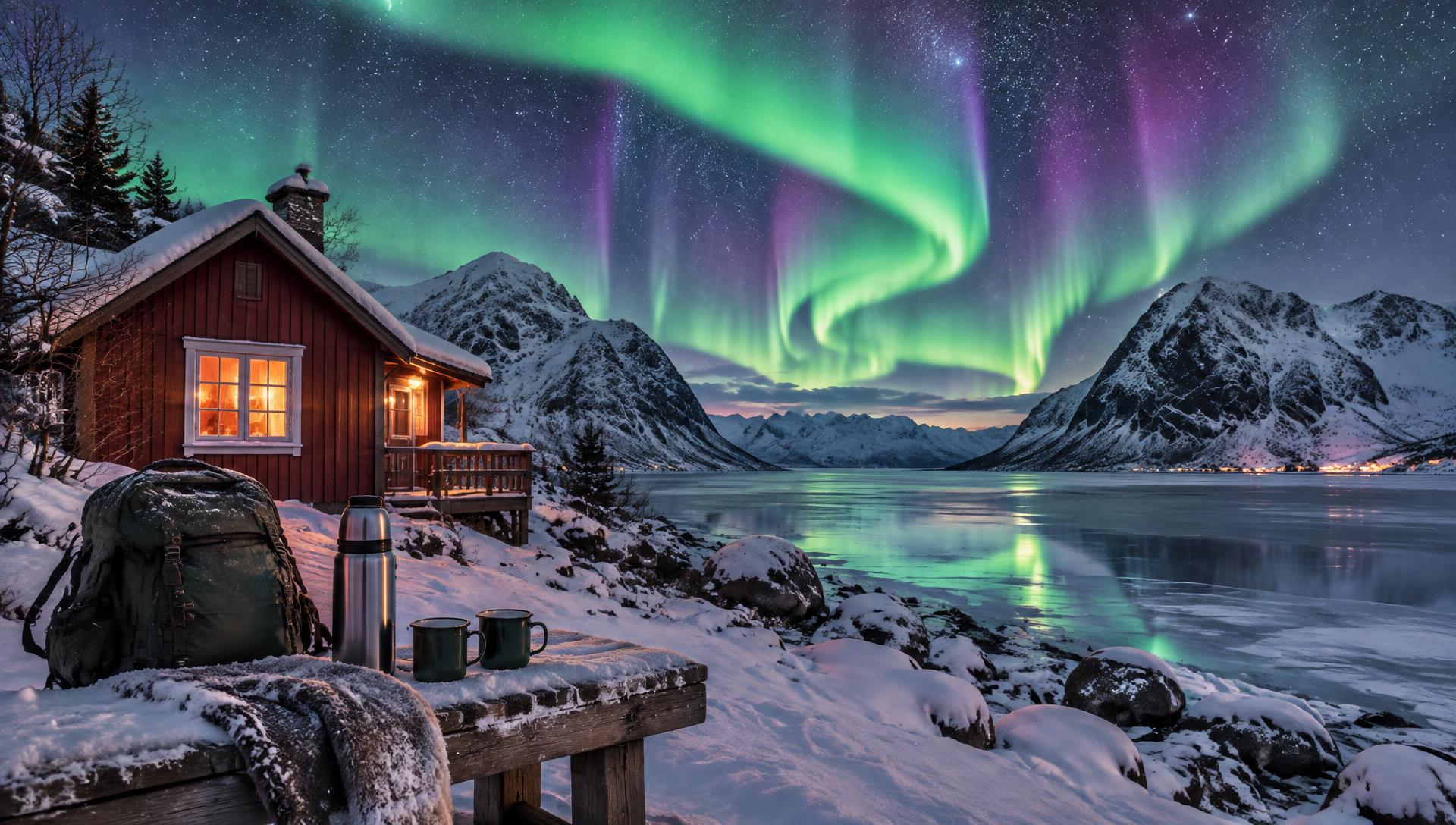
Imagine standing outside in northern Norway a thousand years ago. It's the middle of winter, there's not a single streetlight in sight, and suddenly the sky starts glowing green.
Within minutes, enormous curtains of light stretch across the horizon. They move, disappear and return, sometimes turning red or illuminating the snow-covered landscape.
You have no idea what's causing it.
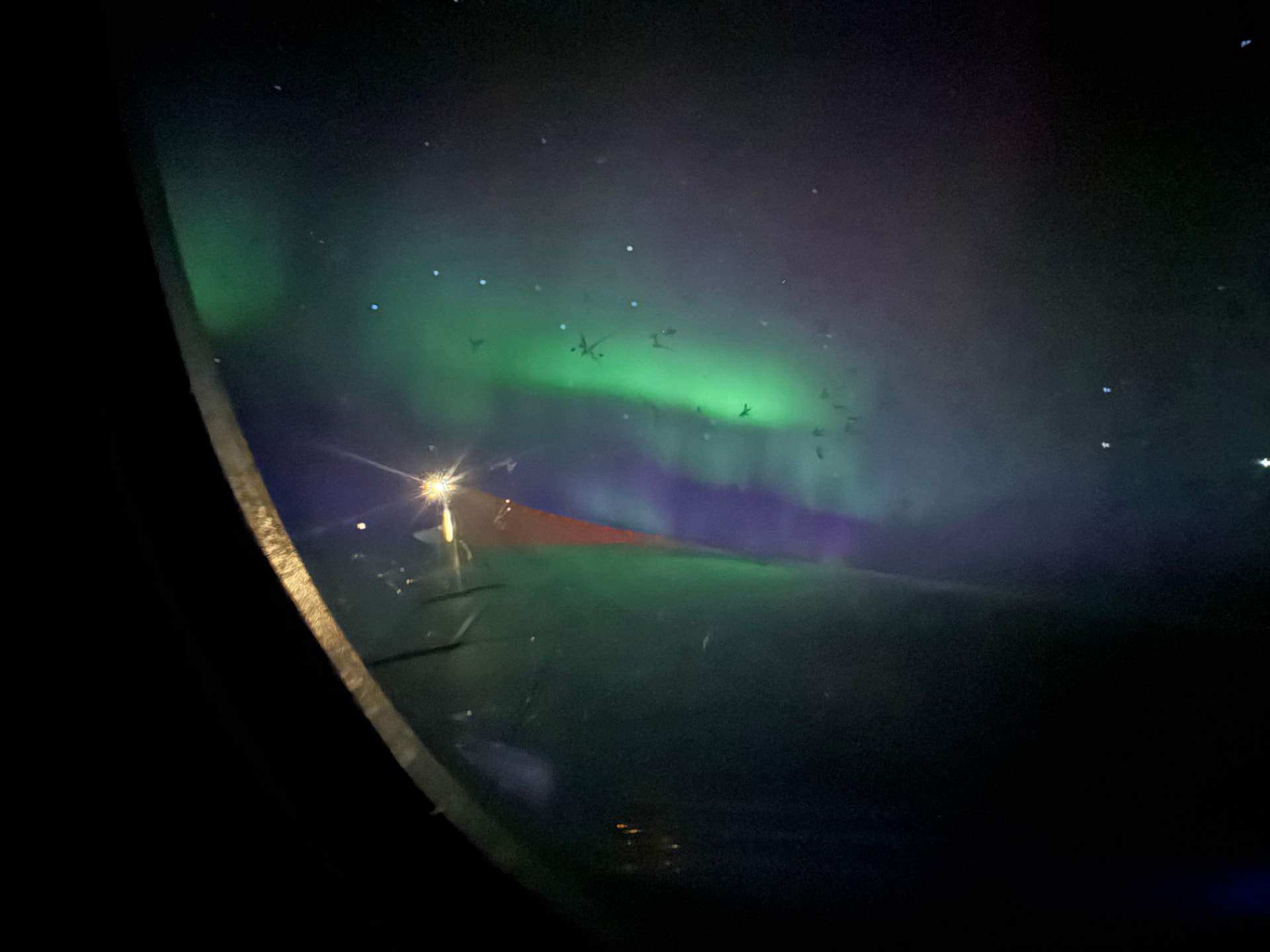
Today, we can check northern lights forecasts on our phones, follow solar storms in real time and even get notifications when aurora activity increases.
Our ancestors weren't quite as fortunate.
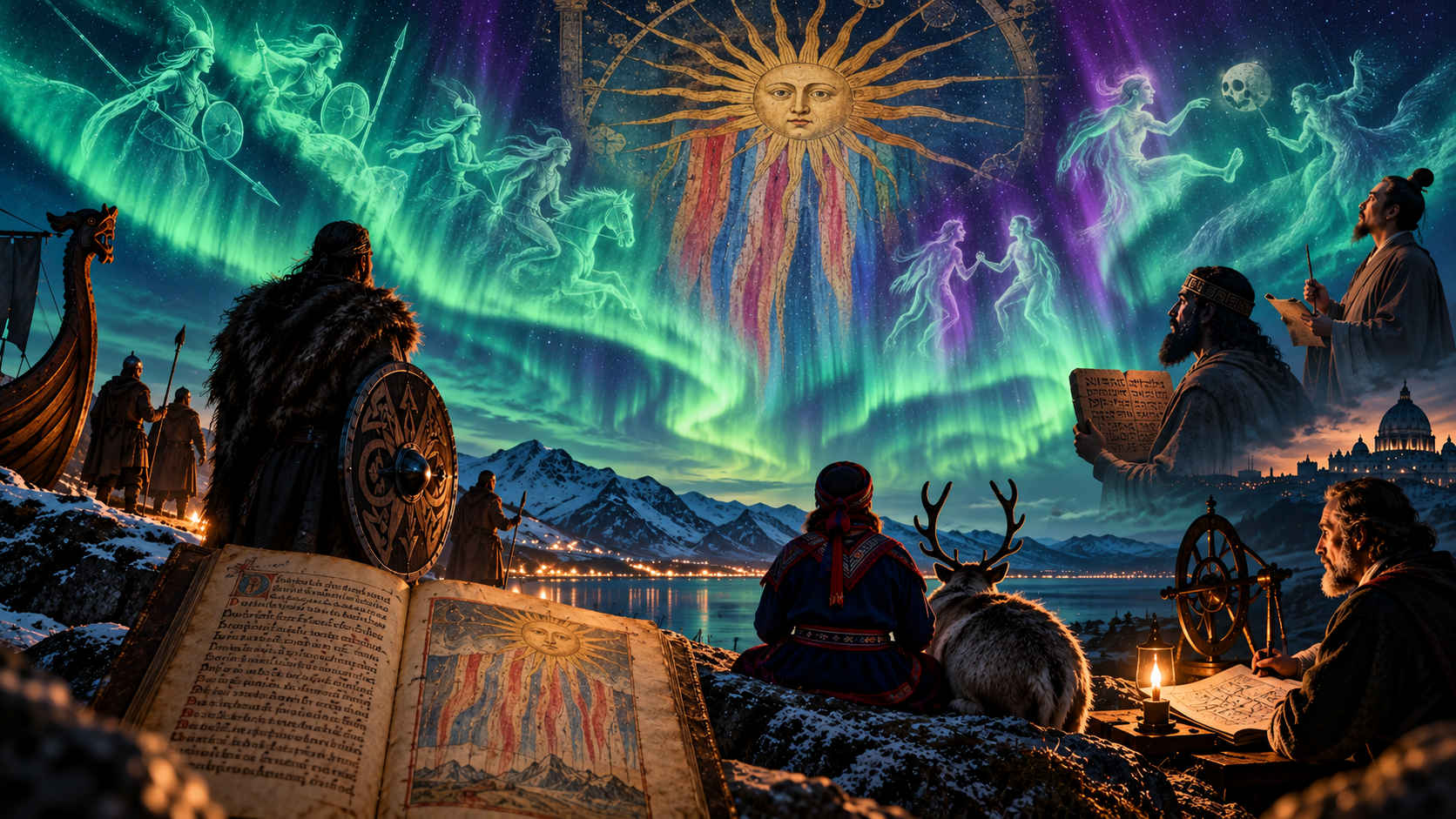
Yet people have been watching the northern lights for thousands of years. Some of the oldest possible written accounts date back nearly 3,000 years, while medieval manuscripts contain surprisingly detailed descriptions of what people saw.
And some of the stories are considerably stranger than you might expect.
Before Electricity, the Night Sky Was a Different Place
There's something we tend to overlook when discussing historical northern lights observations.
For most of human history, light pollution simply didn't exist.
No illuminated cities, streetlights, highways or industrial areas lighting up the horizon. Once the sun went down, the landscape became genuinely dark.
That must have made quite a difference for people living in northern Scandinavia, Iceland, Greenland and other regions where auroras regularly occur.
Even relatively faint displays would have been easier to spot.
Of course, this doesn't mean the northern lights appeared more frequently in the past. Solar activity has always varied, and Earth's magnetic field has changed over time.
But people had darker skies, and many spent considerably more time outdoors.
For someone returning from a fishing trip or travelling between settlements during winter, seeing the northern lights might not have been particularly unusual.
Today, tourists travel halfway around the world and spend thousands of euros hoping to experience the same thing.
The interesting question is what earlier civilizations actually thought they were looking at.
Ancient China: A Mysterious Light Nearly 3,000 Years Ago
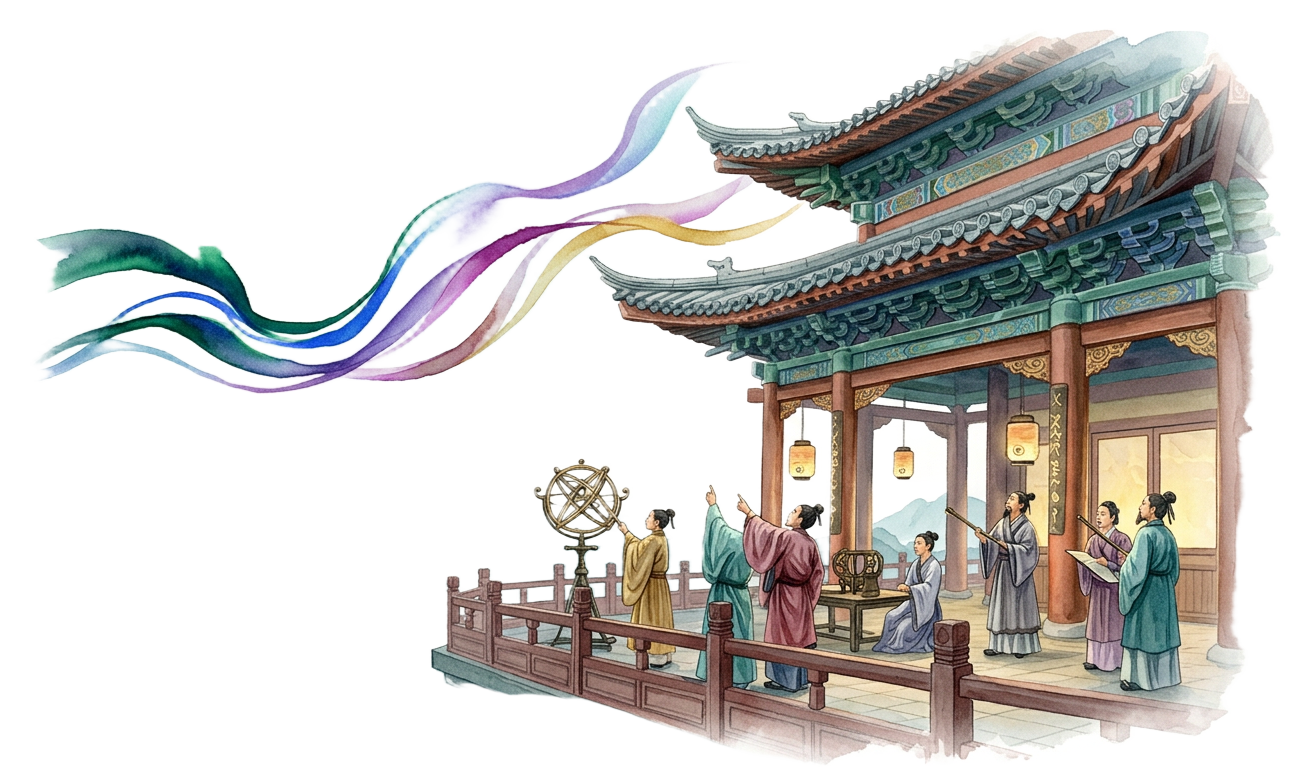
One of the oldest possible written descriptions of the northern lights comes from ancient China.
The Bamboo Annals, a collection of historical records associated with early Chinese rulers, contains an account of a mysterious five-coloured light appearing in the northern sky.
Researchers have suggested that the event occurred around 977 or 957 BC.
That's nearly 3,000 years ago.
What's particularly interesting is the location. The observation is associated with Haojing, an ancient capital near present-day Xi'an, considerably farther south than the places we normally associate with the northern lights.
However, powerful solar storms can push auroral activity much farther from the poles than usual.
Researchers studying the historical account concluded that an aurora is a plausible explanation, although the dating and interpretation aren't completely certain.
If they're correct, someone in ancient China witnessed an extraordinary display long before anyone understood the connection between the Sun and Earth's magnetic field.
And the Chinese weren't alone.
Ancient Assyria: When a Red Sky Was Bad News
Around 680–650 BC, astronomer-astrologers in the Assyrian Empire were carefully observing the night sky.
Their work wasn't just about understanding the stars. Celestial events were believed to carry messages about the future of the king and his kingdom.
An unusual event in the heavens could therefore be taken very seriously.
Fortunately, many of their observations were recorded on clay tablets, some of which have survived for more than 2,600 years.
In 2019, researchers identified three possible aurora observations in these ancient reports.
They describe strange red glows and clouds appearing in the sky.
While we usually associate the northern lights with green curtains, powerful geomagnetic storms can produce spectacular red auroras, sometimes visible surprisingly far south.
And if you've never seen the northern lights before, a blood-red sky appearing in the middle of the night might be rather unsettling.
Today, we'd probably reach for our cameras.
An Assyrian astronomer would have been more concerned about what the event meant for the king.
What makes these records particularly valuable is that scientists can now use them to investigate solar activity thousands of years before modern instruments existed.
The Vikings Lived Where We Now Travel to See the Northern Lights
Here's something we find particularly interesting about the Vikings.
They happened to live in many of the very places people now travel halfway around the world to visit in search of the northern lights.
Norway, Iceland and Greenland were all part of the Norse world. Northern Scandinavia also included communities living beneath some of Europe's most active auroral skies.
Of course, not every Viking settlement was equally well positioned. Someone living in Denmark would have had a very different experience from someone spending the winter in northern Norway.
But the Norse certainly occupied regions where spectacular displays could be seen.
Think about that for a moment.
Today, people plan entire holidays around the possibility of seeing the northern lights. A thousand years ago, some of the people living in these regions could simply step outside on a clear winter night.
So what did they think about them?
Surprisingly, we don't really know.
Clear descriptions of the northern lights are remarkably scarce in surviving Viking Age sources.
Much of Norse culture was passed down orally, and many of the stories we associate with Viking mythology were written down centuries later.
That makes it difficult to separate genuine Viking Age beliefs from later interpretations.
Were the Northern Lights Reflections From Valkyries' Shields?
One of the most popular stories claims that the Vikings believed the northern lights were reflections from the shields and armour of the Valkyries.
In Norse mythology, Valkyries were supernatural women associated with Odin who selected fallen warriors and were connected with Valhalla.
It's a fantastic image.
Warriors riding across the heavens, their shining armour illuminating the Arctic sky.
There's just one problem.
We don't have strong historical evidence that Viking Age Scandinavians actually connected the northern lights with the Valkyries in this way.
The Valkyries are well documented in Norse mythology, but the specific connection to the aurora is much harder to trace.
It doesn't mean nobody ever believed it. We simply can't present it as an established Viking belief.
Fortunately, we do have a much better documented Scandinavian account from the Middle Ages.
And it's surprisingly scientific.
The King's Mirror: A Norwegian Explanation From 1250
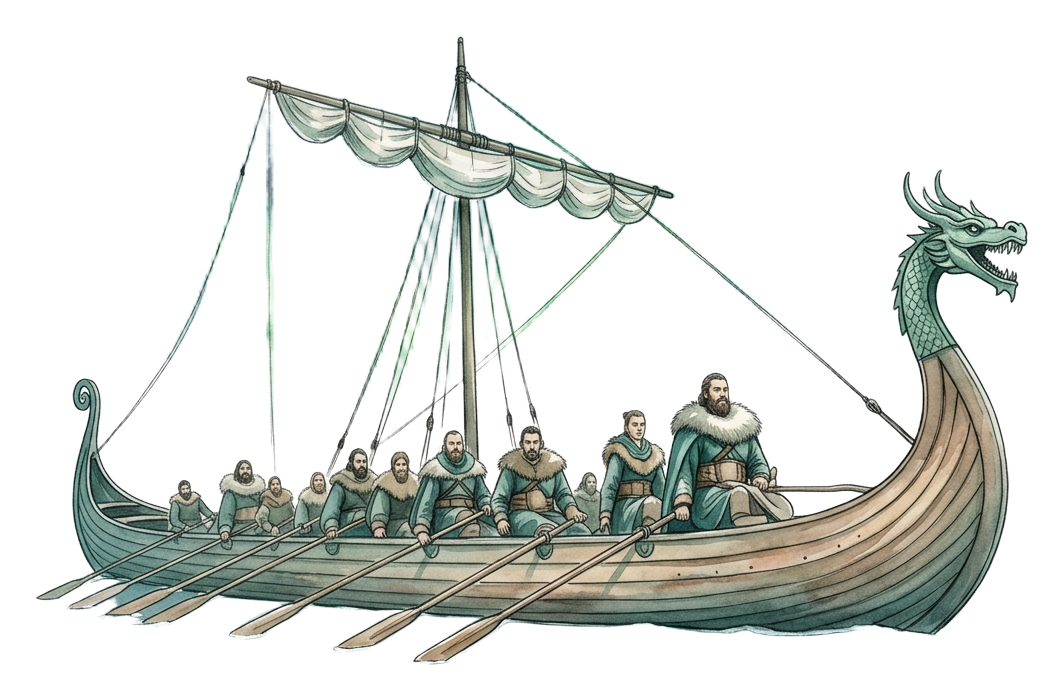
Around 1250, an unknown Norwegian author wrote Konungs skuggsjá, commonly known in English as The King's Mirror.
The book covers everything from trade and kingship to geography and natural phenomena.
Among its discussions of Greenland is a detailed description of the northern lights.
The author describes a mysterious glow resembling a distant fire, with rays stretching upward into the sky.
He notes how the lights change position and brightness, sometimes becoming powerful enough to illuminate the surroundings.
But what makes the account particularly interesting is the attempt to explain what causes them.
Rather than simply blaming supernatural forces, the author presents three possible theories.
The first suggests that an enormous belt of fire surrounds the ocean, and Greenland lies close enough to see its glow.
The second proposes that sunlight somehow reaches the northern sky even when the Sun is below the horizon.
The third is perhaps the most creative: Greenland's extreme cold, frost and glaciers might generate light themselves.
The author appears to favour the final explanation, while acknowledging that nobody really knows the answer.
All three theories turned out to be wrong.
But considering this was written almost 800 years ago, the approach is impressive.
Here was a medieval Norwegian writer comparing different physical explanations and openly admitting that the phenomenon remained a mystery.
It's also one of the clearest early indications that people in the Norse world were familiar with the northern lights.
The Sámi: A Sky That Deserved Respect
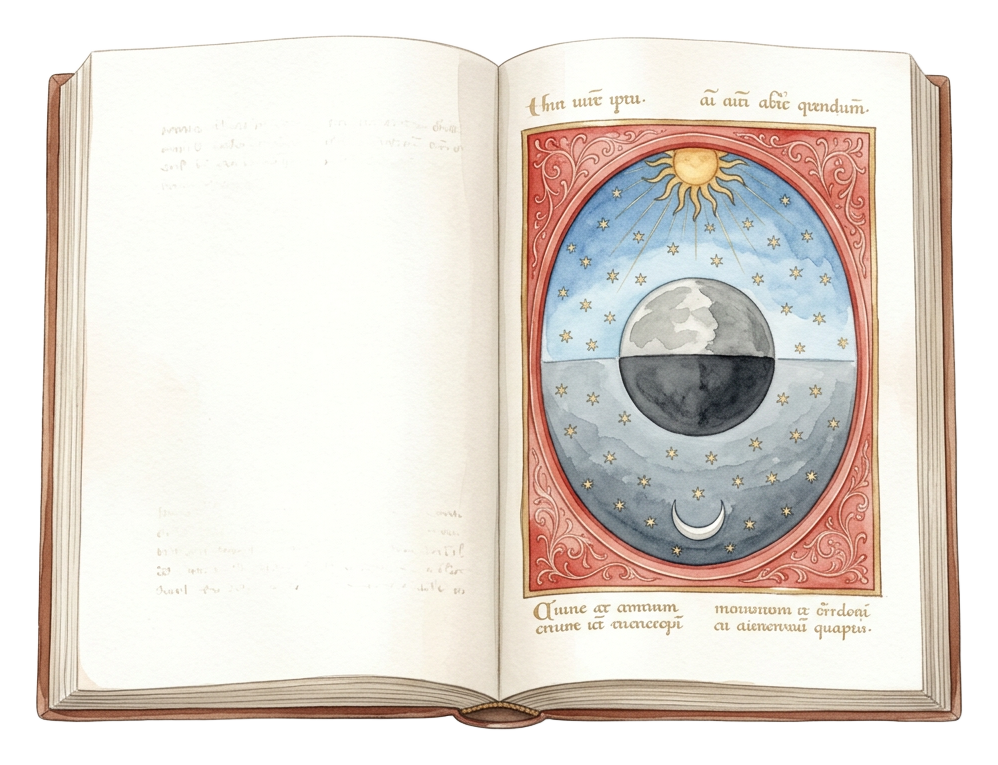
While the Vikings tend to receive most of the attention in stories about northern Scandinavia, we also need to talk about the Sámi.
The Sámi are the Indigenous people of Sápmi, a region stretching across northern Norway, Sweden and Finland, as well as Russia's Kola Peninsula.
And Sápmi happens to include many of the destinations we now consider among the best places in the world to see the northern lights.
For generations, Sámi communities have lived beneath these Arctic skies, developing their own stories and traditions around the aurora.
But unlike modern tourists, who generally hope for the most spectacular display possible, people in some Sámi traditions were taught to be careful around the lights.
They weren't necessarily something to celebrate.
They were something to respect.
Spirits, Souls and the Northern Lights
In some Sámi traditions, the northern lights were associated with the spirits of the dead.
Certain eastern Sámi accounts connected the lights with people who had died violent deaths, while other traditions described the aurora as a powerful phenomenon that shouldn't be provoked.
It's important to remember that Sámi traditions differ between communities. There was never one universal explanation shared by everyone across Sápmi.
Still, the idea that the northern lights could react to human behaviour appears in several recorded traditions.
And that brings us to one of our favourite stories.
Why You Shouldn't Whistle at the Northern Lights
In some Sámi traditions, people were warned against whistling, waving or otherwise teasing the northern lights.
The belief was that attracting their attention could be dangerous.
If you provoked them, the lights might descend from the sky and come after you.
That's quite different from modern aurora tourism, where people often stand outside hoping the lights will become more active.
But apparently, not everyone followed the advice.
During the winter of 1882–83, Danish astronomer and photographer Sophus Tromholt spent several months in Kautokeino, northern Norway, studying the aurora.
While there, he also documented local Sámi traditions.
Among them was a children's rhyme used to tease the northern lights.
The rhyme describes the aurora in rather unusual terms, including a hammer-shaped head, drill-like feet and green edges.
Tromholt later published it in his 1885 book Under Nordlysets Straaler.
What makes this account particularly interesting is that it shows two sides of the same tradition.
The northern lights were something to be respected, but children could also find them entertaining enough to tease.
As long as they knew when to stop.
Could the Sámi Hear the Northern Lights?
There's another interesting detail.
Some northern traditions include accounts of people hearing sounds during auroral displays.
The Northern Sámi word guovssahas has sometimes been popularly translated as "the light you can hear", although that interpretation is disputed by language scholars.
The question of auroral sounds is actually still an interesting scientific subject.
Researchers have investigated reports of faint crackling and other noises associated with auroral activity. Some studies suggest electrical phenomena much closer to the ground may explain certain reported sounds.
So we shouldn't assume that the aurora itself produces an audible sound travelling all the way down from the upper atmosphere.
But it's another example of how closely people observed the phenomenon long before modern scientific instruments.
And importantly, Sámi culture isn't simply ancient folklore. It's a living Indigenous culture, with contemporary communities, languages and traditions throughout northern Europe.
Across the Atlantic: Indigenous Stories From North America
The Sámi weren't the only people who developed stories about the northern lights.
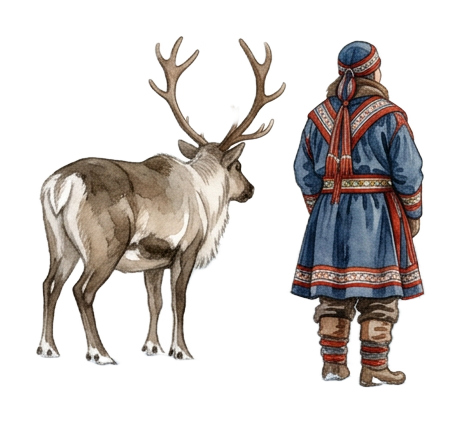
Across Alaska, northern Canada and Greenland, Indigenous communities had their own explanations for the mysterious lights moving above them.
Some of these stories have interesting similarities with traditions from northern Scandinavia.
Others are completely different.
And considering how many distinct Indigenous cultures exist across North America, that shouldn't be surprising.
The Inuit and the Game in the Sky
One of the most unusual stories comes from Inuit traditions.
In some accounts, the northern lights were associated with the spirits of the dead playing a ball game in the sky.
Their ball was said to be a walrus skull.
It's certainly one way to explain the rapid movements of the aurora.
Imagine watching bright curtains of light racing across the sky and believing you were witnessing a game played by spirits.
Other Inuit communities had different explanations, and some regarded the lights with caution rather than amusement.
There is no single Inuit interpretation of the northern lights, just as there is no single Sámi one.
The Ojibwe: When Ancestors Dance in the Sky
Among some Ojibwe communities, the northern lights have been associated with ancestors and the spirit world.
Rather than viewing them as something threatening, the lights could represent a connection between the living and those who had passed away.
Ojibwe Elder Robert Houle has described the northern lights in terms of ancestors communicating and dancing.
It's a rather different interpretation from the frightening red skies recorded by ancient Assyrian astronomers.
But it shows how the same natural phenomenon can take on very different meanings depending on the culture observing it.
Don't Whistle at the Aurora
Interestingly, warnings about whistling at the northern lights also appear in Indigenous traditions from Alaska.
The Alutiiq Museum documents Alutiiq and Yup'ik traditions in which whistling could attract the aurora and bring the lights closer.
Depending on the community and the story, that wasn't necessarily something you wanted to happen.
The similarities with Sámi traditions are fascinating, although we shouldn't assume the stories share a common origin.
Different communities can develop similar explanations independently, particularly when observing the same unpredictable natural phenomenon.
There's also a more practical side to this history.
For communities living through long Arctic winters, a bright aurora could provide additional light for travelling and other activities after dark.
The northern lights weren't just something people told stories about.
They were part of the environment in which they lived.
Did the Vatican Record the Northern Lights?
You probably don't associate the Vatican with the northern lights.
Rome isn't exactly famous for its aurora displays.
Yet one of the most interesting early illustrations of a possible aurora survives in the Vatican Apostolic Library.
The manuscript is known as the Chronicle of Zuqnin, a Syriac Christian historical text compiled in the eighth century.
It contains illustrations of unusual celestial events, including possible auroras observed in 771–772 and 773 AD.
The manuscript was written in the region of present-day southeastern Turkey, not Rome, and later became part of the Vatican's collections.
What makes it particularly valuable is that the author didn't simply mention an unusual light.
He attempted to illustrate what people saw.
One description refers to differently coloured, sceptre-like shapes rising into the sky, with one disappearing as another appeared.
The writer interpreted the event as a threatening sign from God.
From a modern perspective, the description is consistent with the appearance of moving auroral rays.
Researchers have identified the drawings as candidates for some of the earliest surviving illustrations of datable auroras.
It's important to remember that these are modern interpretations of historical observations, not definitive proof of what appeared in the sky.
And there's an interesting detail: the same manuscript also contains a possible auroral account dated to 501–502 AD, although that earlier event was recorded retrospectively rather than illustrated by a contemporary eyewitness.
So while we shouldn't claim that the Pope personally recorded the northern lights, the Vatican does preserve an important piece of auroral history.
When the Northern Lights Were Seen as Religious Warnings
Throughout medieval Europe, unusual celestial events could be interpreted as signs from God.
Comets, eclipses, strange colours and unexplained lights sometimes appeared in chronicles alongside accounts of wars, disasters or political upheaval.
A powerful red aurora must have been particularly dramatic.
Imagine seeing the entire northern horizon glowing crimson without understanding what was happening.
It's not difficult to understand why some observers might have considered it a warning.
Of course, historians need to be careful.
Not every medieval account of a red sky or mysterious fire necessarily describes the northern lights.
But the Chronicle of Zuqnin is especially interesting because it combines written descriptions with illustrations that researchers can examine.
Centuries later, on 17 December 1737, a spectacular aurora was observed in Rome and documented by the cleric and mathematician Diego de Revillas.
A manuscript account of the observation survives in the British Library.
By then, European scholars were increasingly trying to understand the lights through systematic observation rather than religious interpretation alone.
Galileo, Halley and the Search for an Explanation
The northern lights were observed long before scientists gave them the name aurora borealis.
The term is often credited to French astronomer Pierre Gassendi, who observed an aurora in 1621.
However, historical research has traced an earlier use of the expression to a work published in 1619 associated with Galileo Galilei.
The name essentially means northern dawn.
It's a fitting description, especially when you consider how powerful red auroras can make the horizon look as though the sun is rising in the middle of the night.
Of course, naming the phenomenon didn't mean scientists understood it.
Early explanations still involved reflected sunlight, atmospheric effects and other theories that would eventually be replaced.
In March 1716, a spectacular aurora appeared across parts of Europe and attracted the attention of astronomer Edmond Halley.
Halley attempted to explain the phenomenon, helping move auroral research toward a more systematic scientific approach.
But one of the most important events in the history of the northern lights was still to come.
The Carrington Event: When the Northern Lights Reached Far South
In September 1859, Earth experienced one of the most famous geomagnetic storms in recorded history.
The event followed intense solar activity, including a bright solar flare observed by British astronomer Richard Carrington.
What happened next was extraordinary.
Auroras appeared across unusually large parts of the world, including regions where they are rarely seen.
Some historical accounts describe displays bright enough for people to read newspapers outdoors at night.
Others reported brilliant red skies that looked almost like distant fires.
But the event wasn't just spectacular.
It also disrupted telegraph systems, which were becoming increasingly important for communication.
Operators experienced unusual electrical currents and equipment problems.
For scientists, it provided compelling evidence that activity on the Sun could have very real consequences here on Earth.
Today, the Carrington Event remains an important reference point when researchers discuss extreme space weather and the potential risks to modern technology.
The Norwegian Scientist Who Helped Solve the Mystery
We can't finish a history of the northern lights without mentioning Kristian Birkeland.
The Norwegian physicist was one of the pioneers of modern auroral research.
Working around the turn of the twentieth century, Birkeland investigated the connection between charged particles, Earth's magnetic field and the northern lights.
He even built laboratory experiments using a magnetised sphere to demonstrate how charged particles could be guided toward magnetic polar regions.
His work helped establish the foundations of modern auroral physics.
Today, we know that auroras occur when energetic particles interact with gases in Earth's upper atmosphere, causing them to emit light.
Oxygen produces much of the familiar green and red colouring, while nitrogen contributes to blue and purple shades.
We also have satellites monitoring the Sun, instruments measuring geomagnetic activity and increasingly sophisticated forecasting systems.
Yet predicting exactly when a spectacular northern lights display will appear remains surprisingly difficult.
Thousands of Years Later, We're Still Looking Up
What we find most interesting about the history of the northern lights is how differently people have interpreted the same phenomenon.
Ancient Chinese observers recorded mysterious colours in the sky.
Assyrian astronomers considered what unusual red lights might mean for their king.
Medieval Norwegians tried to explain the aurora through fire, sunlight and glaciers.
Sámi communities developed traditions about respecting the lights, while some Inuit stories imagined spirits playing games above the Arctic landscape.
And eventually, scientists began piecing together the relationship between the Sun, Earth's magnetic field and the atmosphere.
Today, we understand the northern lights better than any previous generation.
But if you've ever stood outside on a cold Arctic night waiting for the aurora to appear, you'll know that the experience still comes with a certain amount of mystery.
You can follow the forecasts, check the cloud cover and find the perfect viewing location.
Then suddenly, the sky starts moving.
And for a few minutes, it's easy to understand why people have been fascinated by the northern lights for thousands of years.
The good news is that you don't need to travel back in time to experience it.
Northern Norway, Swedish Lapland, Finland, Iceland and parts of North America still offer excellent opportunities to see the aurora.
And unlike the Vikings, we can at least check the forecast before heading outside.
Sources and Further Reading
-
Van der Sluijs & Hayakawa (2023) — A Candidate Auroral Report in the Bamboo Annals. Research into a possible Chinese aurora around 977 or 957 BC.
-
Hayakawa et al. (2019) — The Earliest Candidates of Auroral Observations in Assyrian Astrological Reports. Scientific examination of Assyrian records from approximately 680–650 BC.
-
Konungs skuggsjá — The King's Mirror, English translation. The medieval Norwegian description of the northern lights over Greenland.
-
Guovdageainnu Meahcceguovddáš — Sámi Traditions About the Northern Lights. Sámi beliefs, auroral sounds and Sophus Tromholt's recorded children's rhyme.
-
Sophus Tromholt (1885) — Under Nordlysets Straaler. Historical observations and Sámi traditions recorded in Kautokeino.
-
University of Alaska Fairbanks — Straining to Hear the Voice of the Aurora. Historical Indigenous accounts, including the Inuit ball-game tradition.
-
Alutiiq Museum — Northern Lights (Qiugyat). Alutiiq and Yup'ik traditions involving whistling and the aurora.
-
National Geographic — See North America's Night Sky Through an Indigenous Lens. Indigenous astronomical traditions, including Ojibwe Elder Robert Houle's perspective.
-
Hayakawa et al. (2017) — The Earliest Drawings of Datable Auroras from the Chronicle of Zuqnin. Research into early auroral illustrations preserved in the Vatican Apostolic Library.
-
British Library — Historical manuscript account of Diego de Revillas's aurora observation in Rome, 17 December 1737.
-
NOAA — What Was the Carrington Event?. Historical background on the major geomagnetic storm of 1859.
Ready to pick a place?
Every destination page shows tonight's aurora outlook calculated from its own coordinates.
Explore destinations