It starts with the Sun
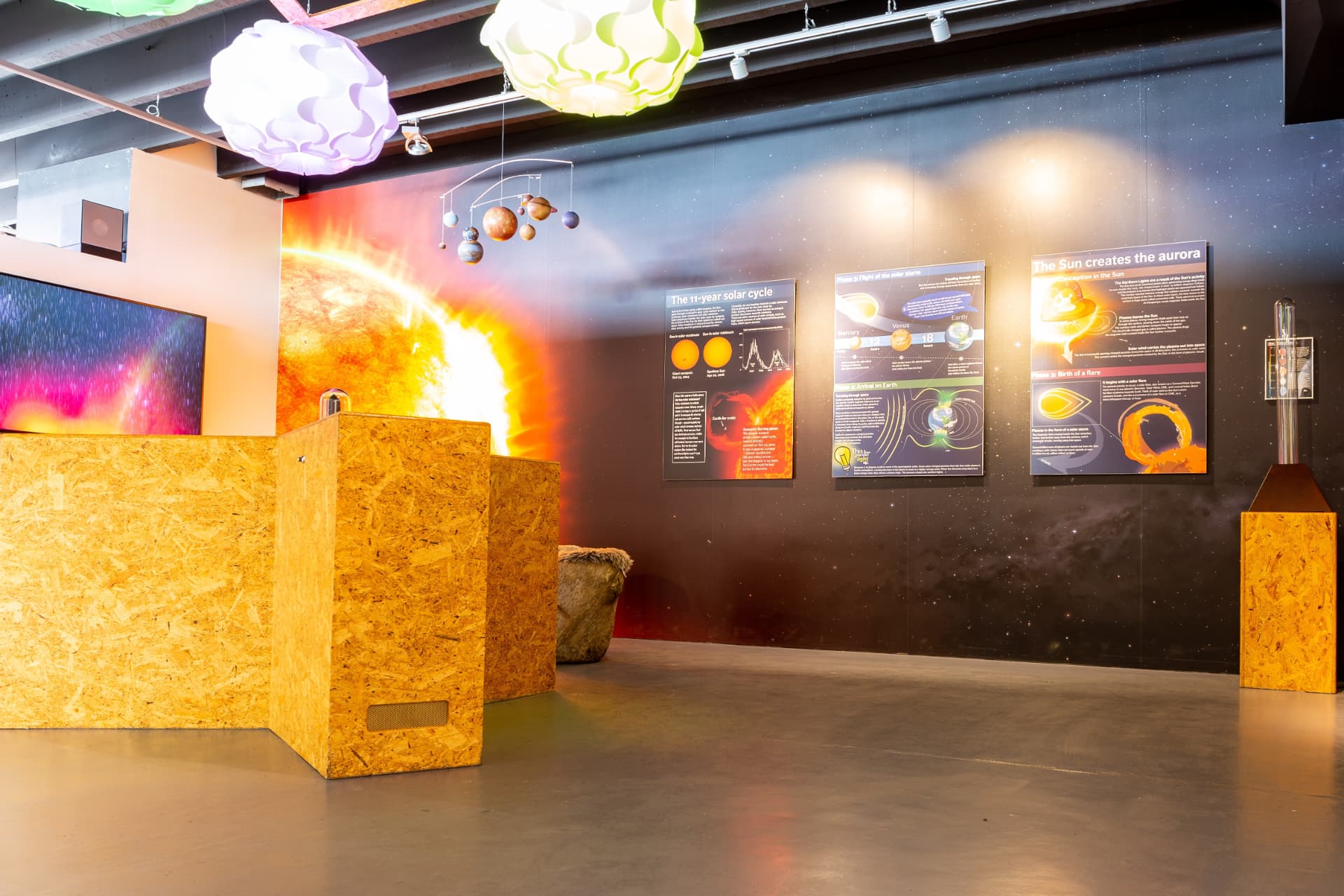
The Sun constantly releases a stream of charged particles into space. This is called the solar wind.
The solar wind travels through the Solar System and eventually reaches Earth.
Most of these particles don't simply enter our atmosphere. Earth is surrounded by a magnetic field that acts as a barrier and redirects much of the solar wind around the planet.
But the interaction between the solar wind and Earth's magnetic field can also transfer energy and particles into the space around Earth.
This is an important part of what eventually produces the Northern Lights.
Earth's magnetic field guides particles towards the poles
Earth's magnetic field extends far into space and creates a region called the magnetosphere.
When energy from the solar wind enters the magnetosphere, charged particles can be accelerated and guided along magnetic field lines towards Earth's polar regions.
They eventually reach the upper atmosphere, where they collide with atoms and molecules.
This is why auroras are much more common at high latitudes than they are near the equator.
The main zone of aurora activity forms a ring around each magnetic pole. This region is known as the auroral oval.
Destinations such as northern Norway, northern Sweden and northern Finland are often under or close to this oval, which is why they can see the Northern Lights regularly during the dark season.
What happens when the particles reach the atmosphere?
This is where the light is actually produced.
Charged particles entering the upper atmosphere collide with oxygen atoms and nitrogen molecules.
These collisions transfer energy to the gases.
The oxygen and nitrogen don't hold on to that extra energy for long. When they return to a lower-energy state, they release energy in the form of light.
Millions of these interactions happening across a large area of the upper atmosphere create the aurora we see from the ground.
Why are the Northern Lights usually green?
Green is the most common aurora color, and it mainly comes from oxygen.
The exact color depends on several factors, including which gas is involved and the altitude where the interaction takes place.
Green: The familiar green aurora is produced by oxygen and is commonly seen at altitudes of roughly 100 to 150 kilometers. Because this type of emission is relatively easy for our eyes to see, green is the color most people associate with the Northern Lights.
Red: Oxygen can also produce red aurora at higher altitudes. Red displays are less common and can sometimes appear above a green auroral arc. During strong geomagnetic activity, red aurora may become much more noticeable.
Blue and purple: Nitrogen contributes to blue, purple and pink colors. These colors can appear along the lower edges of active auroral curtains, although they are usually less dominant than green. Cameras often capture these colors more clearly than our eyes do.
Why do the Northern Lights form different shapes?
The aurora isn't a fixed layer of light.
Charged particles move along Earth's magnetic field, and conditions in the magnetosphere are constantly changing.
From the ground, this can produce arcs, bands, rays and large curtain-like structures.
A quiet aurora might remain as a faint arc for a long time. When activity increases, the same part of the sky can become much brighter and start changing shape quickly.
We explain this in more detail in [What Causes the Northern Lights to Dance?].
Why are some aurora displays much stronger than others?
The solar wind is not constant.
Its speed, density and magnetic properties change. The Sun can also produce large eruptions that send material and magnetic fields into space.
When conditions are right, the interaction with Earth's magnetosphere can become much stronger. More energy enters the system, and aurora activity can increase.
This can make the Northern Lights brighter, more active and visible over a larger area than usual.
It can also allow aurora to be seen much farther south.
What are solar flares and coronal mass ejections?
These terms often appear in Northern Lights forecasts, but they aren't the same thing.
A solar flare is a sudden release of energy from the Sun. It produces radiation that can reach Earth very quickly.
A coronal mass ejection, usually shortened to CME, is a large eruption of plasma and magnetic field from the Sun's outer atmosphere.
A CME directed towards Earth can reach our planet days later and sometimes cause a geomagnetic storm.
That can lead to stronger aurora activity, although a CME does not automatically mean there will be a spectacular display where you are standing.
Its direction, speed and magnetic properties all matter.
What does the KP index have to do with it?
The KP index is a measure of global geomagnetic activity.
It runs from 0 to 9. Higher numbers generally mean stronger geomagnetic activity and a greater chance of seeing aurora farther away from the polar regions.
But a high KP number is not required to see the Northern Lights in the Arctic.
If you're in a place such as Tromsø or Abisko, you can see aurora during relatively low geomagnetic activity because you're already close to the auroral oval.
See our [guide to the KP index] for a more practical explanation of how to use it.
Do the Northern Lights happen every night?
Auroral activity occurs very frequently around Earth's polar regions, but that doesn't mean you'll see it every night.
First, you need darkness.
During summer, northern Scandinavia has very bright nights or Midnight Sun. Aurora may still be occurring high above Earth, but the sky is too bright for you to see it.
You also need a clear view of the sky. Clouds can completely hide an active aurora.
Finally, aurora activity itself changes throughout the night.
This is why seeing the Northern Lights depends on a combination of aurora activity, darkness and weather.
If you're planning a trip, our [best time to see the Northern Lights] guide explains how these factors change throughout the year.
How high are the Northern Lights?
The Northern Lights happen much higher above Earth than many people realize.
Most visible aurora occurs roughly 90 to several hundred kilometers above the ground, depending on the type of emission.
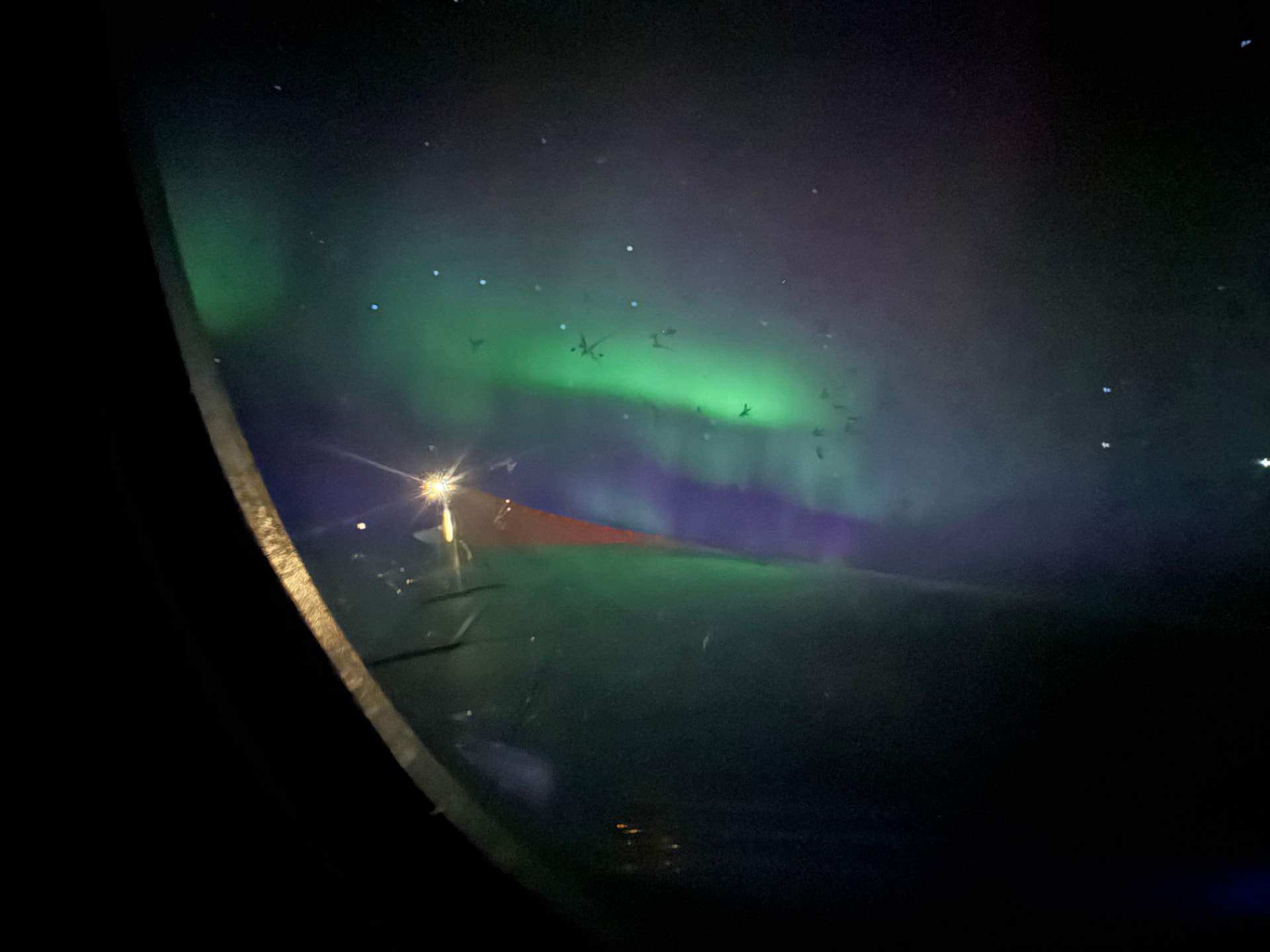
For comparison, commercial passenger aircraft normally fly at around 10 to 12 kilometers.
So when you stand underneath an auroral curtain, the light you're looking at is being produced far above the clouds and weather.
That's also why clouds block your view of the Northern Lights: the aurora is happening above them.
Northern Lights and Southern Lights are the same process
Aurora doesn't only happen in the north.
The same physical process takes place around Earth's southern polar region, where it is called the Aurora Australis, or Southern Lights.
In the north, it is called the Aurora Borealis.
Both are produced by charged particles interacting with Earth's magnetic environment and upper atmosphere.
The names are different because of where we see them, not because they are different phenomena.
The simple explanation
If you want the whole process in a few steps:
The Sun sends charged particles through space in the solar wind.
The solar wind interacts with Earth's magnetic field.
Energy and particles enter Earth's magnetosphere.
Charged particles are accelerated towards the polar upper atmosphere.
They collide with oxygen and nitrogen.
Those gases release energy as visible light.
That light is the aurora.
The details can get much more complicated, but you don't need to understand space physics to understand the basic process.
The Northern Lights begin with the Sun, are shaped by Earth's magnetic environment and become visible when particles interact with the atmosphere above us.
Ready to pick a place?
Every destination page shows tonight's aurora outlook calculated from its own coordinates.
Explore destinations